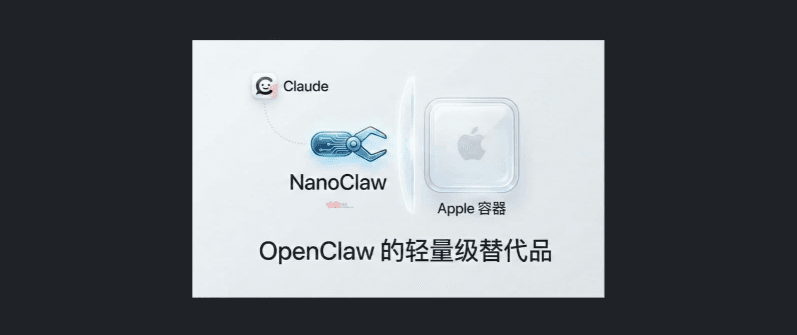
NanoClaw Resolves OpenClaw Security Flaws and Enhances Performance
TL;DR
NanoClaw, developed by Gavriel Cohen, addresses security concerns of the open-source AI assistant OpenClaw, ensuring safer execution in work environments using Linux containers to isolate its operations.
The new tool NanoClaw, developed by Gavriel Cohen, addresses security concerns associated with the open-source AI assistant OpenClaw. Released on January 31, 2026, NanoClaw ensures safer execution in work environments by using Linux containers to isolate its operations.
OpenClaw, released in November 2025, quickly gained popularity among developers and businesses, offering a powerful way to automate tasks. However, its permissionless architecture raised concerns, especially regarding potential security vulnerabilities.
The solution provided by NanoClaw addresses this vulnerability through an operating-system-level isolation model. All execution processes of the tool occur within containers, which limits AI interactions to only the directories specified by the user.
The containers used include **Apple Containers** for high performance on macOS and **Docker** for Linux environments, creating a secure and controlled environment. Cohen notes that previous approaches utilizing internal safeguards can be fragile. "I don't let an agent run loose on my machine. There will always be a way to escape if it's running directly on the host," he states.
A Robust Security Implementation
NanoClaw is the result of criticism towards bloated code and auditing. Cohen realized that OpenClaw had code with nearly 400,000 lines, making review and maintenance difficult. "Such extensive code is not reliable," Cohen comments, highlighting the risks associated with complexity.
In contrast, NanoClaw was developed with only **500 lines of TypeScript**, making its auditing feasible in a matter of minutes. The use of a Node.js orchestrator allows for efficient message management, avoiding the complexity of larger systems.
Additionally, support for **Swarm Agents** through the **Anthropic Agent SDK** enhances NanoClaw's functionality, enabling specialized agents to work concurrently without compromising sensitive data across different functions.
Reinventing the Software Model
The central proposition of NanoClaw is the emphasis on "Skills" instead of a feature-heavy software. Cohen describes the tool as "AI-native software," designed to be managed through AI interactions rather than manual configurations.
Contributions of broad new features are discouraged; instead, developers are encouraged to offer "Skills" that empower the local assistant. "If you want Telegram, remove WhatsApp and switch," suggests Cohen, promoting customizable software.
This approach allows users to execute simple commands like "\/add-telegram," integrating new functionalities without the overhead of unnecessary modules.
Practical Application in an AI Agency
The use of NanoClaw is not just theoretical. The go-to-market agency Qwibit, co-founded by the Cohen brothers, employs NanoClaw in its operations, with an instance called "Andy." "Andy manages our sales pipeline," says Cohen, demonstrating the tool’s efficiency.
He reports that the agent provides daily updates on lead statuses and automates follow-ups, showcasing efficient data capture and processing.
Strategic Assessment for Businesses
In a rapidly transforming landscape, decision-makers face the choice between convenience and control. NanoClaw represents an efficient and secure model, facilitating the implementation of new AI technologies without the risks associated with more complex systems.
NanoClaw's methodology can be advantageous not only for developers but also for security leaders. A core of 500 audit-ready lines provides a solid foundation in an environment of growing data security concerns.
Cohen recommends that security teams evaluate the tool, stating that the review can be completed in an afternoon, enabling the identification of attack vectors and increasing confidence in system security.
NanoClaw, therefore, proposes a shift in the mindset of AI developers. As technology advances, the simplicity of the software that underpins it may be the key to success in modern business automation.
Content selected and edited with AI assistance. Original sources referenced above.